


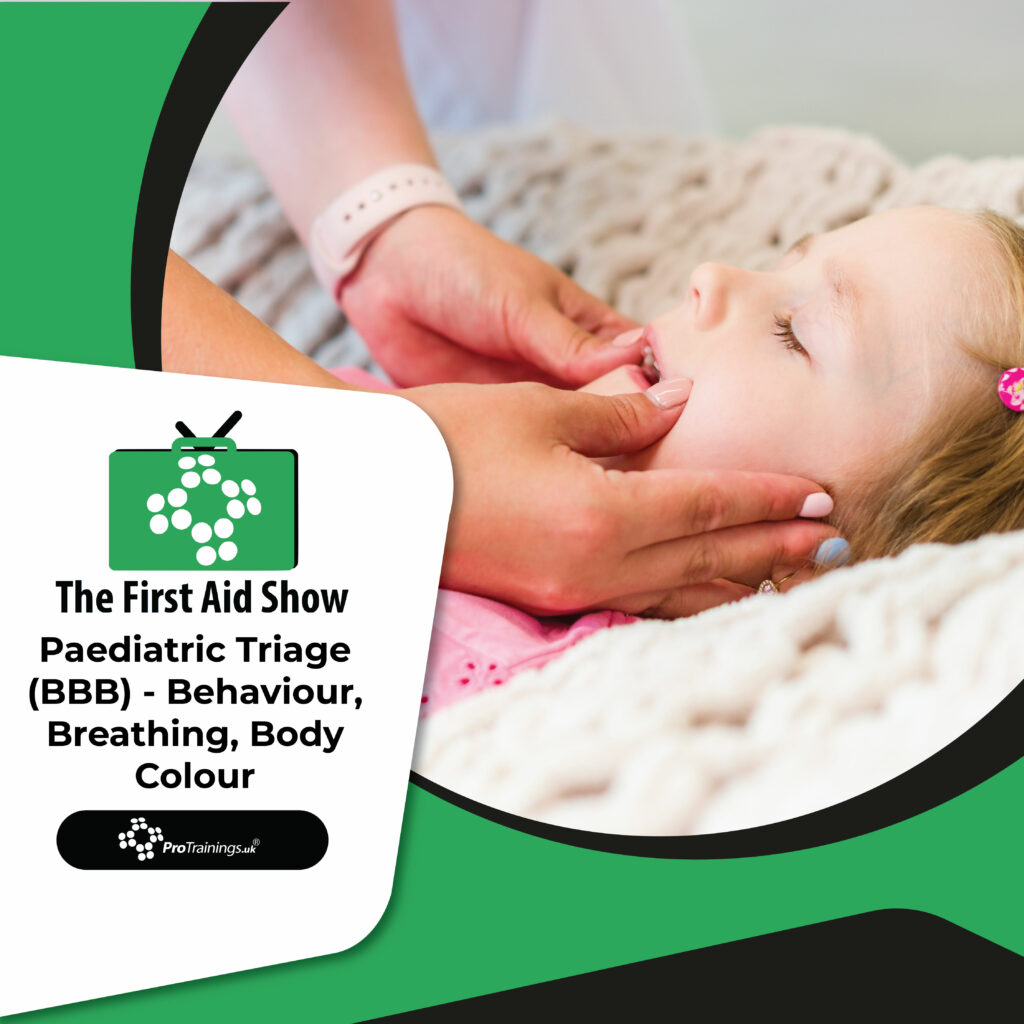

When responding to a potentially unwell child, it is vital to act quickly and confidently. One of the most effective and easy-to-remember tools is the Paediatric Triage (BBB) – Behaviour, Breathing, Body Colour. This method allows anyone, including non-clinicians, to rapidly assess whether a child is seriously ill. Crucially, the Paediatric Triage (BBB) – Behaviour, Breathing, Body Colour system is recommended by both the Resuscitation Council UK and ERC 2025. It is designed to guide your assessment even before monitors or medical professionals arrive.
Behaviour: Start with Brain Function
First, observe how the child is behaving. This step often reveals the earliest signs that something is wrong. Is the child alert? Are they making eye contact, responding to their surroundings, or acting appropriately for their age? If not, this is a red flag.
Take urgent action if the child seems drowsy, is hard to wake, or appears floppy or stiff. Other concerning signs include seizures, uncharacteristic agitation or confusion, or inconsolable crying. Furthermore, if they suddenly lose movement in a limb, or can’t speak or walk when they previously could, these are serious indicators. Always treat these behaviours as urgent warnings.
Breathing: Next, Watch and Listen
After behaviour, assess how the child is breathing. Difficulty breathing often points to a serious underlying issue. Watch for fast breathing, visible effort such as nostril flaring or rib retraction, or any unusual noises like grunting or wheezing. If the breathing is slow, irregular, or stops altogether, this signals a life-threatening emergency. Immediate support is essential. Even subtle changes matter, especially if posture is affected or the child uses extra muscles just to breathe.
Body Colour: Finally, Assess Circulation
Lastly, check the child’s body colour. This offers clues about oxygen delivery and blood circulation. Look for blue or grey lips, tongue, or fingertips. Pale, ashen, or mottled skin may also signal poor perfusion or shock. For children with darker skin tones, examine the gums, palms, or lips closely. These subtle signs often go unnoticed but can be critical.
Think in Triangles
Altogether, Behaviour, Breathing, and Body Colour form a triad. Each part connects to the others. If two or more areas show abnormalities, the child is likely very unwell. Delay at this stage can lead to rapid deterioration. Therefore, always act without hesitation. Early recognition saves lives.
In summary, the BBB approach gives you a structured, simple, and highly effective method to assess a child in distress. Use it every time. Learn it. Share it. And above all, trust it. It could make the difference between life and death.